
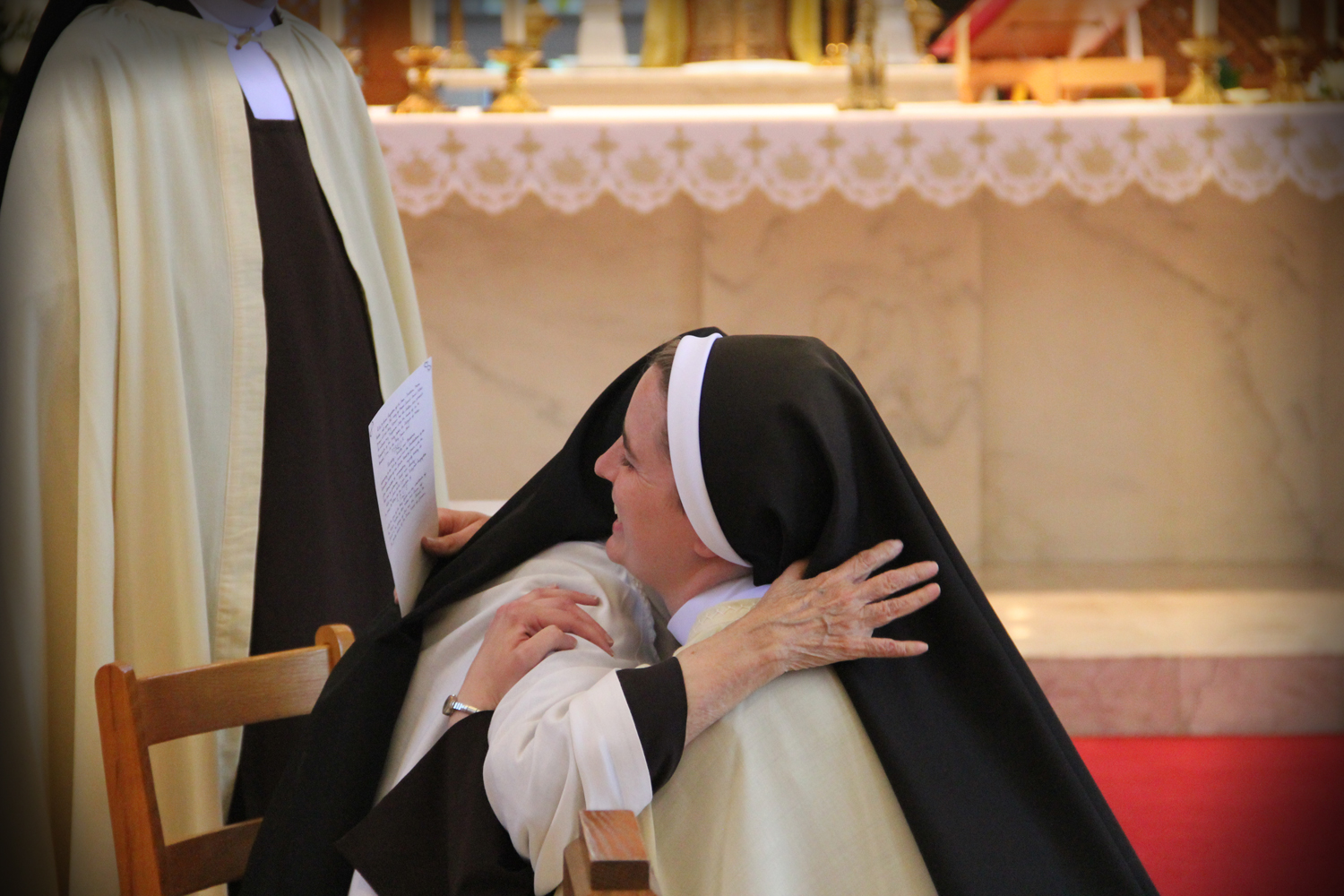
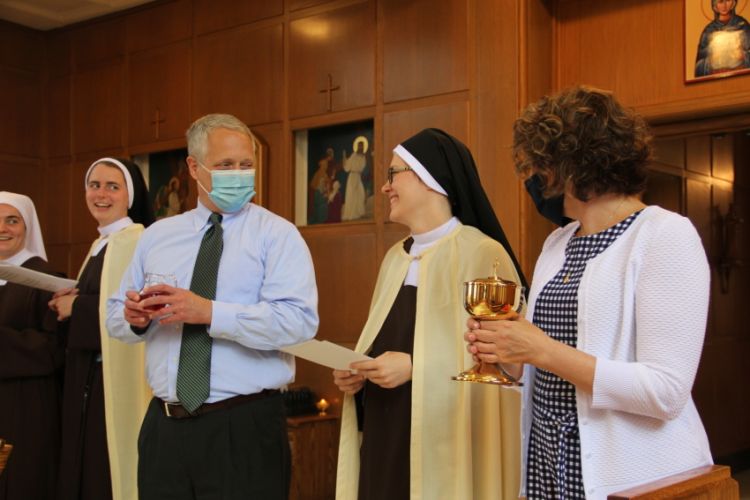
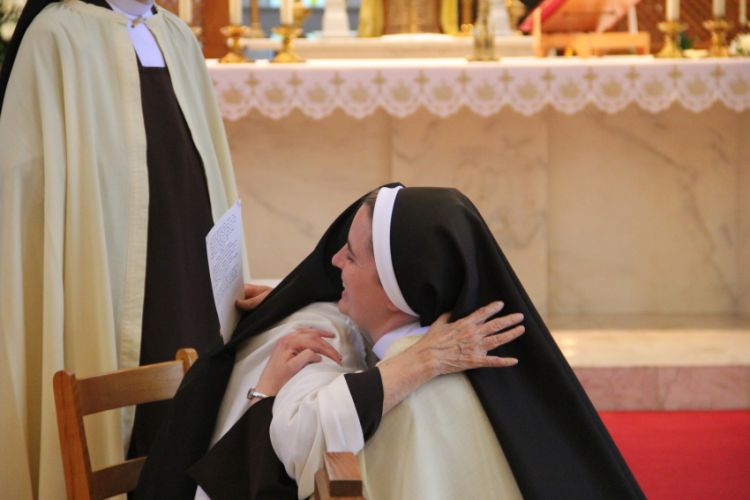
As I was preparing for Final Vows this year, I was asked by someone, “How can a young woman make vows “Forever?” I think I responded with something short and sweet, like “Grace!” I wish I had said, “God is Love. Love is eternal.”
Recently, the professed community was reading Man’s Search for Meaning during spiritual reading. In it, Dr. Viktor Frankl, a psychiatrist and expert in theoretical and clinical psychology who survived horrific experiences in various concentration camps during World War II, makes the argument that the key to human survival is the person’s conviction that his life has a purpose beyond himself. At one point, he recalls in stirring terms how the love of his wife literally saved his life one day:
And as we stumbled on for miles, slipping on icy spots, supporting each other time and again, dragging one another up and onward, nothing was said, but we both knew: each of us was thinking about his wife… A thought transfixed me: for the first time in my life I saw the truth as it is set into songs by so many poets, proclaimed as the final wisdom by so many thinkers. The truth – that love is the ultimate and the highest goal to which man can aspire. (p.37)
Frankl’s wife was not physically present. He did not know if she was still alive. But his love for her was the daily bread which reenergized his vigor for life. I appreciated this insight and recount of lived experience, because it heightened my awareness that love is binding and supersedes temporal and spatial structures; in other words, “Love is eternal.”
We all desire this eternal love. Through God’s grace, we are all capable of participating and sharing in this love, this binding and total exchange of selves. In his apostolic letter, Vita Consecrata, St. John Paul II highlights this mystery of eternal love as revealed in Religious Life when he proclaims:
This is the meaning of the call to the consecrated life: it is an initiative coming wholly from the Father (cf. Jn 15:16), who asks those whom he has chosen to respond with complete and exclusive devotion. The experience of this gracious love of God is so deep and so powerful that the person called senses the need to respond by unconditionally dedicating his or her life to God, consecrating to him all things present and future, and placing them in his hands. (17)
I recalled this excerpt frequently as I was preparing for Final Vows. The Religious Sister’s impetus for vowing her life to God must always be the reception of the deep, powerful and gracious love of God. As she receives this gift, her free response is to love as deeply, powerfully and graciously as a creature can: giving everything back to the One who gives everything. When Final Vows are understood as a young woman’s response to Eternal Love, the suggestion of a temporary commitment conditioned by temporal satisfaction is recognized as a skewed response. God’s being is love, and He is eternal. The question is whether our response to Love is grounded in love. If it is, the vows are eternal.
So, great question and please pray that my life becomes an adequate reply. After receiving the love of God, I hope my utterance of “Forever” is only natural - or, should I say, supernatural: “God is Love. Love is eternal.”
- 1
- 2
- 3
- 4
- 5